
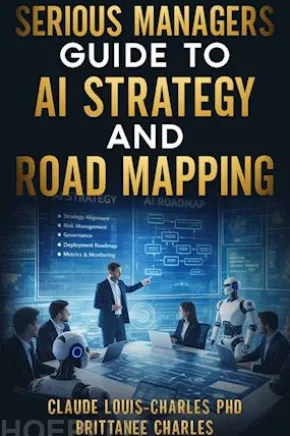
Serious Managers Guide to AI Strategy and Road Mapping
€6.71
Compatibilità
- Computer
- Android
- Ebook Reader
- iPhone/iPad”
- Kindle
Dettagli
Genere:E-book EPUB
Lingua: Inglese
Editore:
Cybersoft Publishing LLC
Pubblicazione: 04/2026
Trama
AI has moved from experimentation to the center of organizational strategy, yet most leaders still struggle to answer the most important questions: Where do we start? What should we build? How do we ensure AI is safe, responsible, and aligned with our mission? This book gives managers the clarity, structure, and practical tools they need to lead AI adoption with confidence. It begins with the real challenge—AI is no longer a technical problem but a managerial one—and provides a step-by-step roadmap for turning ambition into execution.
Inside this book, readers will learn how to:
• Build an AI strategy grounded in mission, outcomes, and organizational priorities
• Assess readiness across data, people, processes, and culture before investing
• Identify, evaluate, and prioritize high-value use cases that avoid hype and fragmentation
• Design an AI operating model that defines ownership, workflows, and human-in-the-loop roles
• Create a 90-day roadmap that drives momentum, alignment, and measurable progress
• Run AI pilots that scale instead of stalling in “proof-of-concept limbo”
• Implement responsible AI practices that reduce risk and strengthen trust
• Lead teams through cultural change, skill shifts, and new ways of working
• Build sustainable AI capability through templates, frameworks, and repeatable processes
Organizations that skip strategy quickly fall into predictable traps: disconnected pilots, shadow AI, duplicated efforts, unclear ownership, and wasted investment. This book shows managers how to avoid those pitfalls by reframing AI as workflow transformation, not tool deployment. It explains why AI strategy must begin with mission alignment, why roadmapping is essential for sequencing and prioritization, and why managers—not technical teams—are now central to AI success.
Readers gain a clear mental model of what AI can and cannot do, grounded in four capability categories: classification, prediction, generation, and reasoning. The book cuts through hype and provides practical guidance for evaluating feasibility, risk, and value without needing a data science background. It also addresses the human side of AI adoption—fear of job displacement, resistance to change, misaligned incentives, and unclear roles—offering communication strategies and leadership practices that build trust and confidence.
With hands-on workbooks at the end of each chapter, this guide turns concepts into action. Managers learn to map pressures, diagnose fragmentation, clarify decision rights, and build a living AI strategy they can refine over time. The workbook approach helps leaders “fail on paper and adjust on paper,” reducing risk before implementation.
Whether you work in healthcare, public sector, enterprise operations, or mission-driven environments, this book provides the frameworks, templates, and real-world examples needed to lead AI responsibly and effectively. It is a practical, manager-focused blueprint for building an AI strategy that is safe, scalable, and aligned with organizational mission—while giving teams the clarity and confidence they need to adopt AI successfully.
Inside this book, readers will learn how to:
• Build an AI strategy grounded in mission, outcomes, and organizational priorities
• Assess readiness across data, people, processes, and culture before investing
• Identify, evaluate, and prioritize high-value use cases that avoid hype and fragmentation
• Design an AI operating model that defines ownership, workflows, and human-in-the-loop roles
• Create a 90-day roadmap that drives momentum, alignment, and measurable progress
• Run AI pilots that scale instead of stalling in “proof-of-concept limbo”
• Implement responsible AI practices that reduce risk and strengthen trust
• Lead teams through cultural change, skill shifts, and new ways of working
• Build sustainable AI capability through templates, frameworks, and repeatable processes
Organizations that skip strategy quickly fall into predictable traps: disconnected pilots, shadow AI, duplicated efforts, unclear ownership, and wasted investment. This book shows managers how to avoid those pitfalls by reframing AI as workflow transformation, not tool deployment. It explains why AI strategy must begin with mission alignment, why roadmapping is essential for sequencing and prioritization, and why managers—not technical teams—are now central to AI success.
Readers gain a clear mental model of what AI can and cannot do, grounded in four capability categories: classification, prediction, generation, and reasoning. The book cuts through hype and provides practical guidance for evaluating feasibility, risk, and value without needing a data science background. It also addresses the human side of AI adoption—fear of job displacement, resistance to change, misaligned incentives, and unclear roles—offering communication strategies and leadership practices that build trust and confidence.
With hands-on workbooks at the end of each chapter, this guide turns concepts into action. Managers learn to map pressures, diagnose fragmentation, clarify decision rights, and build a living AI strategy they can refine over time. The workbook approach helps leaders “fail on paper and adjust on paper,” reducing risk before implementation.
Whether you work in healthcare, public sector, enterprise operations, or mission-driven environments, this book provides the frameworks, templates, and real-world examples needed to lead AI responsibly and effectively. It is a practical, manager-focused blueprint for building an AI strategy that is safe, scalable, and aligned with organizational mission—while giving teams the clarity and confidence they need to adopt AI successfully.
Be the first to review “Serious Managers Guide to AI Strategy and Road Mapping”
Related products

€7.56

€9.26

Ebook
€6.71

Cucina
€2.54

€14.44

€6.79

Biografie
€5.86

€1.61

Biografie
€2.54


Ebook
€5.09

Ebook
€6.71

Ebook
€1.61


Ebook
€14.36

Ebook
€3.39

Reviews
There are no reviews yet.